I read books for three reasons.
First, to learn something new.
Second, to validate my understanding, values, and practices.
Third, to understand perspectives that may not have occurred to me before.
Reading is a humbling experience. It challenges assumptions, expands imagination, and triggers new lines of thought, often in unexpected ways. It also gives me the confidence to let go of those imposter syndromes and makes me more authentic and myself.
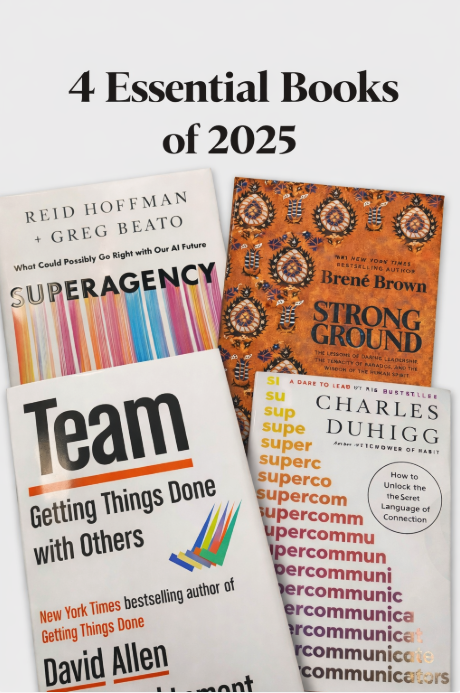
Last year, these four books stood out as my favorites.
Strong Ground by Brené Brown
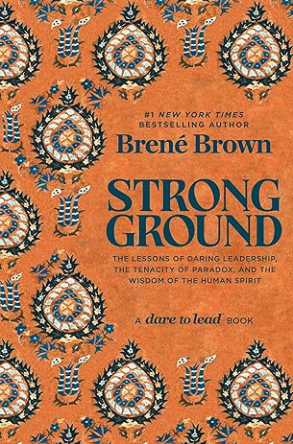
I believe leadership is rarely black and white. It is nuanced. Leadership is an art that requires intention, reflection, purpose and continuous practice. Strong Ground is a masterpiece to developing those skills needed to become a genuine and an effective leader.
At the heart of the book is the idea that authentic leadership requires a strong grounding. Brené Brown makes it clear that leadership demands courage, and courage cannot exist without vulnerability. Self-awareness and self-love are not optional; they are foundational. A courageous leader is not fearless. We all experience fear, and those who claim otherwise are often being inauthentic.
One of the most compelling aspects of the book is its insistence on authenticity, not just practicing it, but being proud of it. I loved how Brené dismissed several commonly accepted leadership myths, calling out ideas like “fake it till you make it,” the so-called “executive presence”, and “charisma leadership”. She draws an important distinction between being nice and being kind. Avoiding hard feedback may feel nice, but it isn’t leadership. True leadership is grounded in courage, empathy, and coaching, embracing discomfort to deliver candid, direct feedback without humiliation.
The chapter that resonated with me the most was on grounded confidence. Brené defines it beautifully:
“Grounded confidence is a brand of confidence built not on arrogance or posturing, but rather on the solid ground of self-awareness, courage, and practice.”
She lays out a thoughtful framework for building this kind of confidence. This is so needed. In a world where fakeness sells, choosing not to be swayed by it and instead focusing on what truly matters makes a profound difference.
The best book I have read last year.
Team: Getting Things Done With Others by David Allen& Edward Lamont
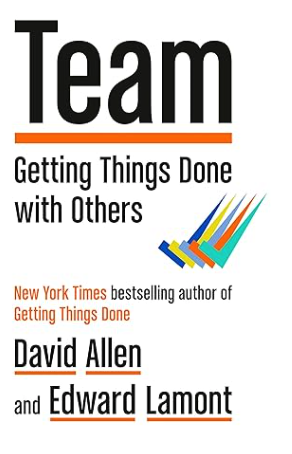
If you’ve read Getting Things Done (I highly recommend) by David Allen, this book is a natural follow-up. While GTD focuses on individual productivity, Team tackles the more complex challenge of how work actually gets done through groups of people.
The book reinforces a core leadership truth: results don’t come from great individuals alone, but from well-integrated teams. Strong leaders build teams that can operate independently and deliver high-quality outcomes without constant direction. Talent by itself isn’t enough. Alignment, trust, and clarity matter more.
One idea that I couldn’t agree more, is the danger of treating everything as a priority. When teams juggle too many “P0” initiatives, quality drops and strategic thinking disappears. This book brings teams back to first principles, clarity, trust, open communication, learning, and diversity of thought as the foundations of sustained performance.
The most powerful theme is purpose. The authors push leaders to clearly define why a team exists and what problems it solves better than anyone else. That sense of purpose brings meaning even to routine work.
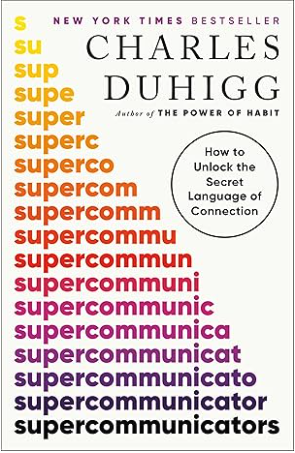
Supercommunicators — Charles Duhigg
Polarization in our society today is palpable. Prejudice, winning at any cost, rigid ideology, ignorance, and fake bravado often dominate our conversations. We’ve reached a dangerous point where the majority belief is mistaken for fact, eroding our shared understanding of truth.
There are many reasons for this divide, but one stands out above the rest, in my humble opinion: we are losing the ability to understand perspectives different from our own. The absence of meaningful conversations, especially with those who disagree with us, is the biggest contributing factor to this problem.
In Supercommunicators, Charles Duhigg encourages practicing deep communication. He does that by introducing the idea of learning conversation. The goal of such a conversation is not persuasion or agenda-driven debate, but genuine understanding, discovering what the other person truly wants. This understanding can only emerge from curiosity, transparency, and empathy, not from direct questioning.
Duhigg emphasizes that great communicators are great listeners and they do more than just process words. They build trust and evoke emotion, creating space for honest and meaningful dialogue. While disagreement is inevitable in any society, the book warns that conflict over facts, when belief replaces truth is deeply dangerous.
At its core, Supercommunicators reminds us that how we communicate matters more than ever. Deep conversations require emotional presence, and emotion involves vulnerability. When someone is vulnerable, trust is built by understanding how they feel, clarifying what they want, seeking permission before offering help, and giving without sounding persuasive or expecting anything in return.
Superagency by Reid Hoffman and Greg Beato
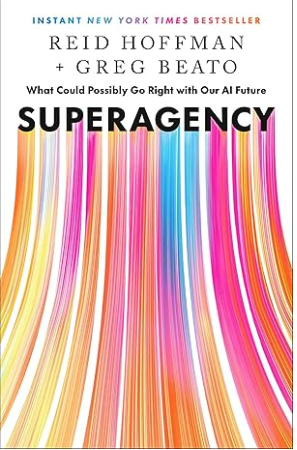
Having spent my career in technology, I’ve been fortunate to be an early adopter and builder of several major tech shifts over the past two decades. Superagency offers one of the most balanced and pragmatic perspectives on the massive shift AI is bringing to humanity.
Rather than debating AI through fear or hype, the book asks a more useful and practical question: What could possibly go right? Hoffman argues that while AI will undoubtedly create disruption and unintended consequences. However, it is neither realistic nor productive to try to reverse course. The ship has sailed. The real challenge is whether we choose to be passive observers or stay in the driver’s seat and shape how this technology serves our society.
The book explores how AI is rapidly evolving across domains such as healthcare, mental health, education, software development, customer support, and research. These shifts are occurring as governments and agencies figure out how to deploy it safely. The global political complexity is certainly making it harder for sure.
The future is filled with more unknowns than known, and that uncertainty is unavoidable. What stood out most to me is the central thesis that innovation itself is the path to safety. The answer to AI risk isn’t stagnation, it’s thoughtful, responsible innovation. Superagency is ultimately an optimistic call to engage, experiment, and lead, rather than retreat in the face of uncertainty. Ask “what could possibly go right?” and take action in that direction.
Prior year books
 Technology, Cybersecurity and Leadership